"Know Your World History".

World History

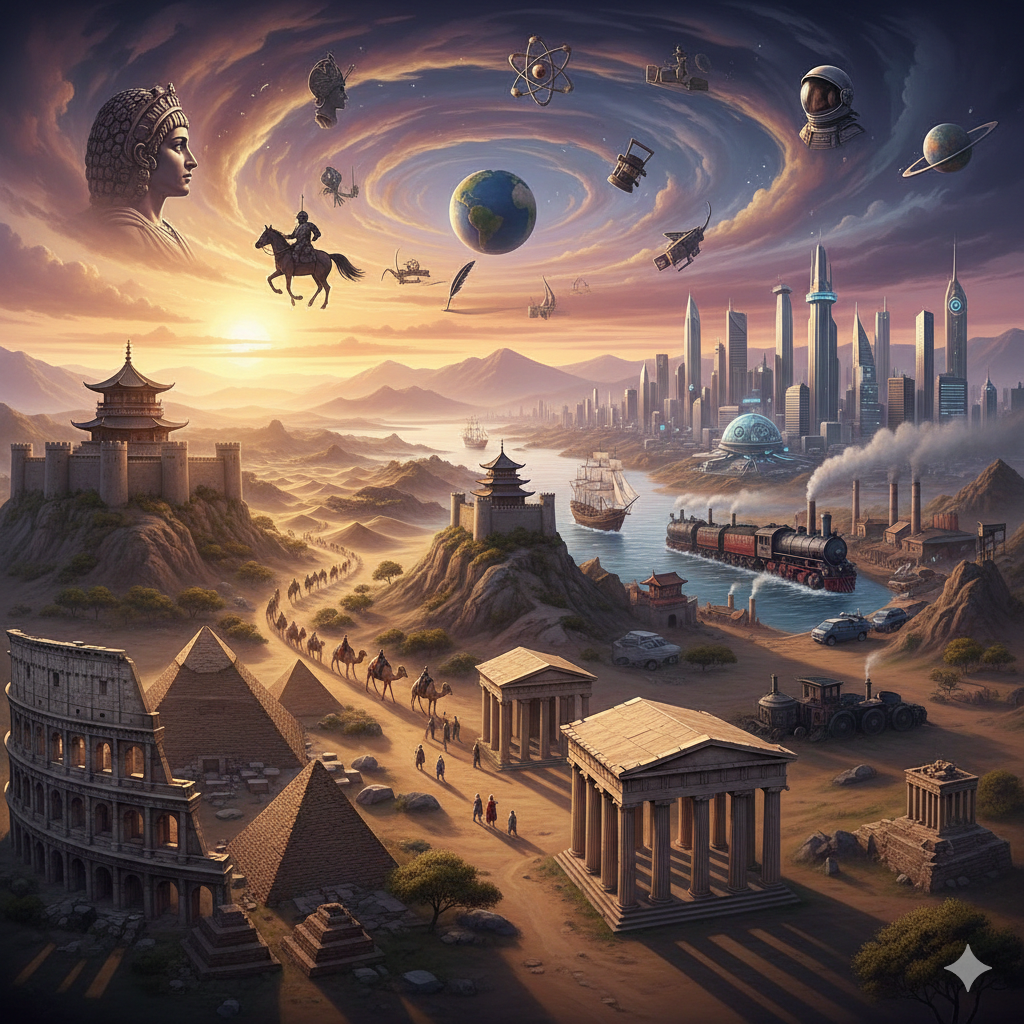
The history of the world is a vast chronicle of human adaptation, beginning with nomadic hunter-gatherers and the pivotal Neolithic Revolution around 10,000 BCE, which introduced agriculture and permanent settlements. This shift birthed the “cradles of civilization” in Mesopotamia, Egypt, the Indus Valley, and China, where the invention of writing and organized law laid the groundwork for complex societies.
History of World
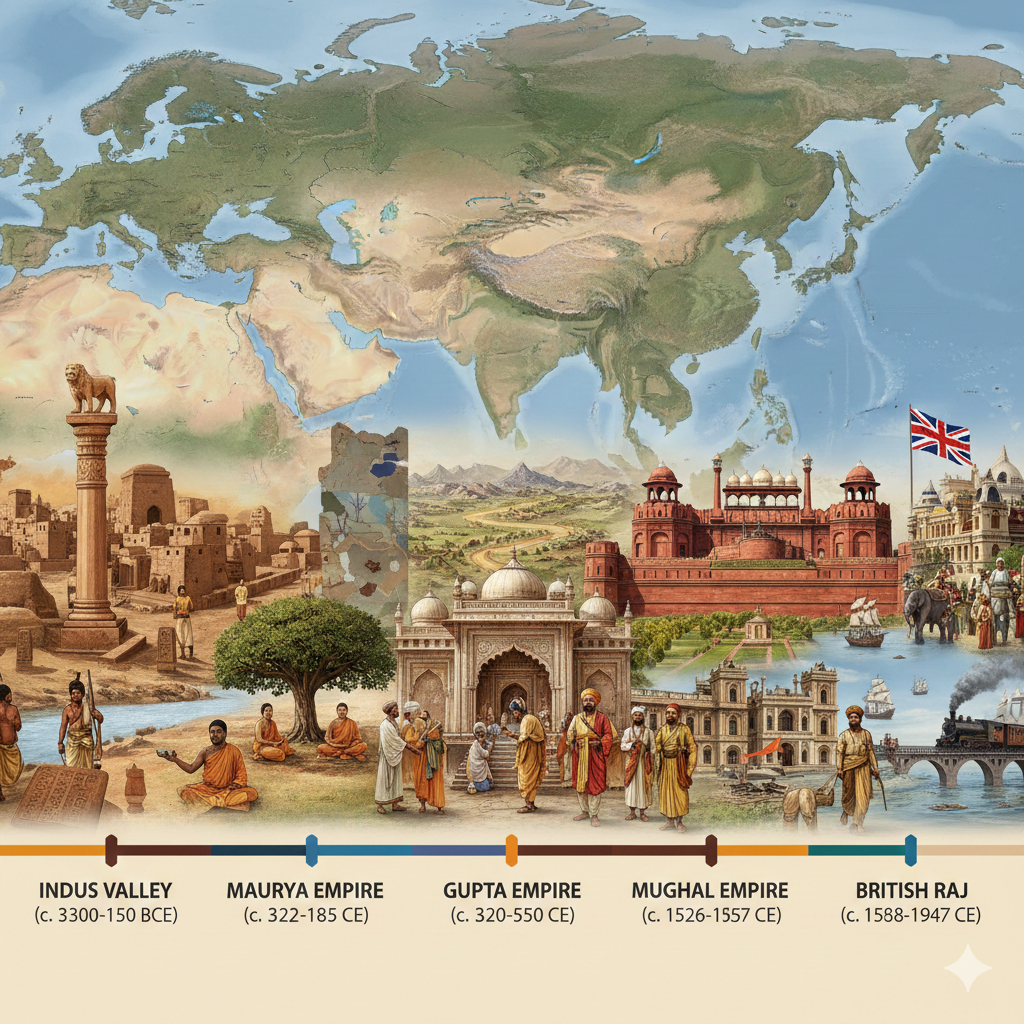
India inASIA

History of Asia

As the world’s largest and most populous continent, Asia’s history is a vast mosaic of independent civilizations that eventually converged through trade and conquest. It is home to the earliest river valley civilizations: Mesopotamia, the Indus Valley, and the Yellow River, where writing, urban planning, and organized religion first emerged.

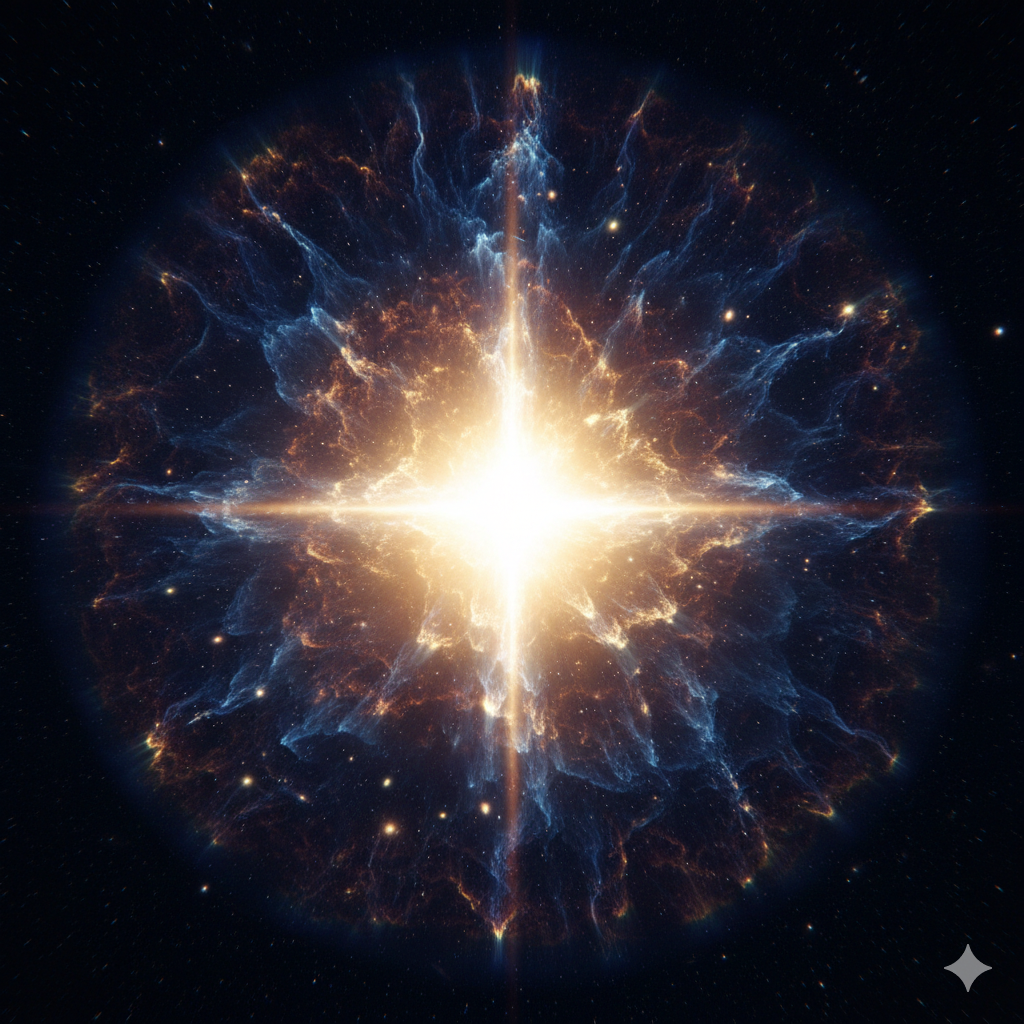
Big Bang Theory

The Big Bang theory is the leading scientific explanation for the origin and evolution of the universe. It proposes that approximately 13.8 billion years ago, the entire universe was concentrated into a single, unimaginably hot and dense point called a singularity.

Key Stages of Development

The history of the universe is defined by distinct epochs:

  • Inflation: In a fraction of a second, the universe underwent an exponential growth spurt, expanding from the size of an atom to larger than a galaxy.

  • Nucleosynthesis: Within the first three minutes, the universe cooled enough for protons and neutrons to form the first atomic nuclei, primarily hydrogen and helium.

  • Recombination: About 380,000 years later, electrons joined these nuclei to form neutral atoms. This allowed light to travel freely for the first time, an “afterglow” we still detect today.

Evidence for the Theory

Scientists support this model through three primary pillars of evidence:

  1. Redshift: Astronomer Edwin Hubble observed that galaxies are moving away from us, with the most distant ones moving the fastest. 

  2. Cosmic Microwave Background (CMB): This faint relic radiation fills the entire sky and serves as a direct “snapshot” of the early universe.

  3. Abundance of Elements: The ratio of light elements (hydrogen and helium) observed in space perfectly matches the theory’s mathematical predictions.

Success story

Boost your conversion Rate

Increase in search traffic
0 x
Increase in Mobile Visit
0 %
Increase in Mobile Visit
0 %
Scroll to Top